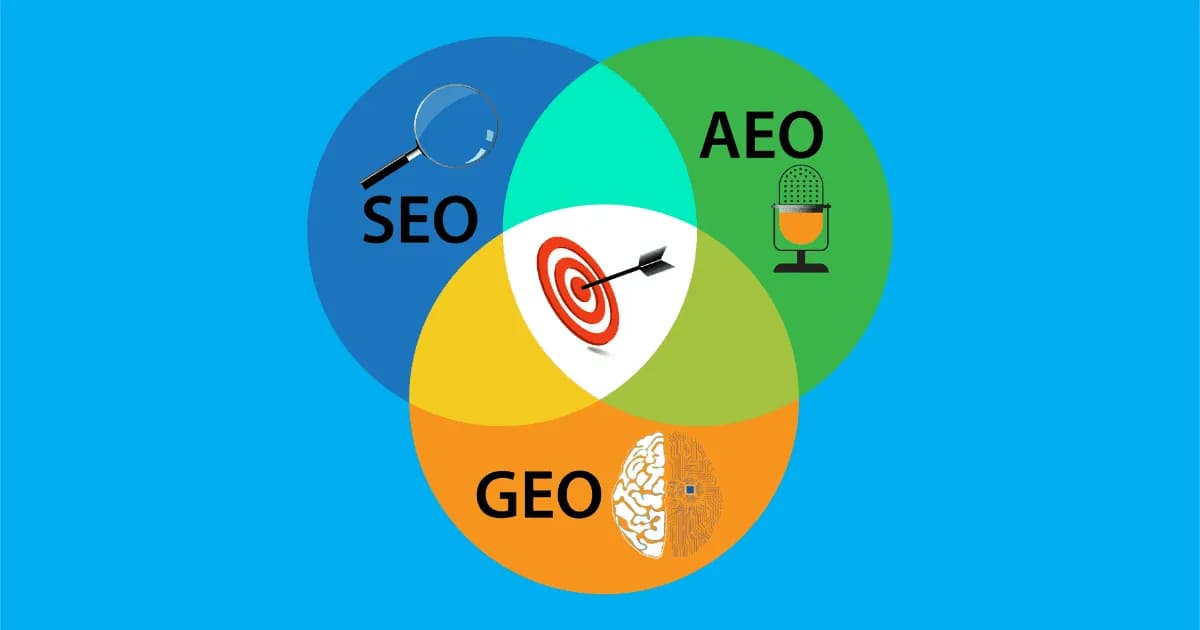
This is the complete guide to SEO, AEO, and GEO, and why your business needs all three.
Search is no longer a single channel; it’s a complete balance between SEO vs AEO vs GEO.
In 2026, your potential customers are finding businesses in at least three distinct ways: through traditional Google search results, through voice assistants and AI-powered answer boxes, and through AI chatbot overviews (such as ChatGPT, Perplexity, and Google's AI. Each of these channels has its own rules and optimization discipline.
That's where SEO, AEO, and GEO come in.
These three acronyms represent the three pillars of modern digital visibility. They overlap, they complement each other, and together form a complete framework for getting your business increased visibility in the digital landscape.
In this guide, we'll break down exactly what each discipline means, how they differ, where they intersect, and how to use all three to grow your business.
Quick Answer: SEO (Search Engine Optimization) focuses on ranking in traditional search engines like Google. AEO (Answer Engine Optimization) focuses on ranking in AI-powered answer features like featured snippets and voice search. GEO (Generative Engine Optimization) focuses on getting your brand cited in AI-generated responses from tools like ChatGPT, Perplexity, and Google AI Overview. All three are essential for complete digital visibility today.
Search Engine Optimization (SEO) is the practice of optimizing your website and content so that it ranks higher in traditional search engine results pages (SERPs), such as Google or Edge. Many businesses optimize for Google, which commands over 90% of the global search market share, but should optimize for all other search engines, such as Edge, Brave, etc.
SEO has been the foundation of digital marketing for over two decades.
At its core, SEO answers one question: when someone types a query into Google, how do you make sure your website appears near the top of the results?
The three pillars of SEO are as follows.
Technical SEO is the behind-the-scenes work that ensures search engines can crawl, index, and understand your website. This includes many items, such as site speed, mobile-friendliness, structured data, XML sitemaps, schema markups, Core Web Vitals, and fixing crawl errors.
On-Page SEO involves optimizing the content and HTML elements of your individual pages, including title tags, meta descriptions, header tags, keyword usage, internal linking, and content quality.
Off-Page SEO is about building authority and trust signals from outside your website, primarily through backlinks from other websites, brand mentions, and digital PR.
A business that invests in SEO will conduct keyword research to identify what their customers are searching for, create high-quality content around those keywords, optimize their website's technical performance, and build backlinks from authoritative sources. Over time, typically 3–6 months, this results in higher rankings and a steady stream of organic traffic. This traffic is what translates to leads and conversions.
Modern SEO is not just about keywords. Google's algorithms now evaluate content through the lens of E-E-A-T: Experience, Expertise, Authoritativeness, and Trustworthiness. Ranking well today requires demonstrating that real, qualified humans created your content, that your website is a trusted source in your industry, and that your content genuinely serves the user's intent, not just matches their query.
Key SEO Stat: Ranking matters enormously. Websites on the first page of Google receive 91.5% of all search traffic. The #1 result gets approximately 28% of all clicks.
Answer Engine Optimization (AEO) is the practice of optimizing your content to be selected and featured by search engines and AI assistants when they're answering direct questions.
The term "answer engine" reflects a fundamental shift in how people search.
For example, instead of typing "best car garage near me" and clicking through results, users increasingly ask conversational questions: "Who is the best dentist in [city]?"
Google, Siri, Alexa, and Cortana now try to answer these questions directly, and AEO is about making sure your content is the answer they choose.
Featured Snippet Optimization means structuring your content to be selected for Google's "position zero," the highlighted answer box that appears above all other organic results. This requires clear question-and-answer formatting, concise definitions, and well-organized lists.
Voice Search Optimization means optimizing for the conversational, long-tail queries people speak rather than type. Voice search queries tend to be longer, more natural, and more question-based ("how do I," "what is the best," "where can I find").
FAQ Schema Markup uses structured data to explicitly mark your FAQ content so search engines can easily extract question-and-answer pairs and display them directly in search results.
Conversational Content means writing in a way that directly answers specific questions in plain language — leading with the answer, then providing supporting detail.
People Also Ask Optimization means identifying the related questions that appear in Google search results for your target keywords, then creating dedicated content that answers each one.
Over 50% of all Google searches now result in zero clicks, the user gets their answer directly from the search results page without ever visiting a website. If your content isn't optimized to appear in these direct answer features, you're invisible to half of your potential audience. AEO is how you win those zero-click positions.
Quick Answer: AEO is most important for businesses in industries where customers have lots of questions — healthcare, legal services, financial services, education, and local services like restaurants or home contractors.
Generative Engine Optimization is the newest and most forward-looking of the three disciplines. GEO is the practice of optimizing your content, brand, and digital presence so that AI language models and generative AI search tools, such as ChatGPT, Perplexity AI, Claude, Google's AI Overview, and Microsoft Copilot, cite, recommend, or reference your business in their AI-generated responses.
To understand why GEO matters, consider what happens when someone asks ChatGPT "What are the best SEO agencies for small businesses?" These AI systems generate answers by synthesizing information from across the web. The businesses and sources they cite become the trusted authorities in the eyes of the user. GEO is about making sure your brand is one of those cited authorities.
Entity Optimization means establishing your brand as a recognized entity in Google's Knowledge Graph and across the web — consistent Name-Address-Phone data, a complete Google Business Profile, and consistent brand mentions across authoritative sites.
Structured Data & Schema Markup uses schema.org markup to explicitly tell AI systems what your content is about — labeling it semantically so machines can understand context, relationships, and meaning.
E-E-A-T Content Creation means publishing content that demonstrates first-hand Experience, deep Expertise, recognized Authority, and Trustworthiness. AI systems preferentially cite content from sources that have demonstrated these qualities.
Citation Building for AI means getting your brand mentioned in sources that AI systems trust most — authoritative industry publications, research studies, government sites, and established media outlets.
AI-Friendly Content Structure means formatting content in ways that AI systems can easily parse — clear headings, factual statements, explicit definitions, well-organized lists, and content that directly addresses specific topics.
AI-generated search is growing at an extraordinary rate. Google's AI Overview now appears in a significant percentage of all search queries. ChatGPT processes over 100 million queries per day. Perplexity is growing rapidly as a preferred search tool for researchers and professionals. These AI tools are not a future trend — they are the present reality of how a growing segment of your audience discovers information and makes decisions.
Key GEO Insight: Businesses that optimize for GEO today are building a competitive advantage that will compound over time, just as early SEO adopters dominated organic search for years. The window to establish early GEO authority is open right now — but not forever.
|
Factor |
SEO |
AEO |
GEO |
|
Focus |
Ranking in Google |
Ranking in answer engines |
Ranking in AI-generated results |
|
Primary Goal |
Organic traffic |
Voice & snippet visibility |
AI citations & brand mentions |
|
Key Tactics |
Keywords, backlinks, technical SEO |
FAQ, schema, conversational content |
Entity optimization, structured data, E-E-A-T |
|
Main Platforms |
Google, Bing |
Google snippets, Alexa, Siri |
ChatGPT, Perplexity, Google AI Overview |
|
Content Style |
Keyword-rich, long-form |
Question-answer format |
Authoritative, entity-rich, factual |
|
Measurement |
Rankings, organic traffic |
Snippet appearances, voice queries |
AI citations, brand mentions in LLMs |
|
Maturity |
Established (30+ years) |
Growing (5–10 years) |
Emerging (1–3 years) |
It would be a mistake to treat SEO, AEO, and GEO as competing priorities. They are deeply interconnected — and the strongest digital marketing programs treat them as a unified framework.
Strong technical SEO is a prerequisite for both AEO and GEO success. If search engines can't crawl and understand your website, AI systems can't either. Your website's authority — built through SEO — is one of the primary signals AI systems use when deciding whether to cite you. You cannot effectively do AEO or GEO without a solid SEO foundation underneath.
AEO sits in the middle of the framework. The FAQ pages, structured data, and question-answer content you create for AEO serve double duty: they help you win Google featured snippets (an SEO benefit) and they create the kind of clearly-structured, easily-parsed content that AI language models prefer to cite (a GEO benefit). AEO investment pays dividends across all three disciplines.
As your GEO strategy builds brand authority and earns citations from high-quality sources, those citations feed back into your SEO (more brand mentions = higher authority) and your AEO (AI-cited brands are more likely to appear in featured snippets and AI answer boxes). The three strategies create a virtuous cycle when executed together.
The Integrated Framework: Think of SEO, AEO, and GEO as concentric circles. SEO is the outer ring — it catches the most users and drives the most volume. AEO is the middle ring — it captures high-intent question-based searches. GEO is the inner ring — it builds brand authority with the most informed, research-driven segment of your audience. All three rings are essential for complete coverage.
Before adding AEO or GEO tactics, ensure your SEO foundation is solid. Fix technical issues (broken links, slow load times, missing meta tags), optimize your most important pages for target keywords, and establish a content strategy that addresses your audience's key questions.
Identify the 20–30 most common questions your customers ask. Create dedicated FAQ sections or standalone pages for each. Write answers in clear, direct language — 40–60 words for the direct answer, followed by more detail. Add FAQ schema markup to these pages and monitor your Google Search Console for featured snippet appearances.
Audit your entity presence: is your business listed consistently across all major directories? Begin a content program that builds topical authority: long-form, expert-level content on your core topics, published regularly and attributed to named authors with verifiable credentials. Pursue coverage in industry publications and build a track record of being cited as a trusted source.
Do I need all three — SEO, AEO, and GEO?
Yes. SEO drives the majority of organic traffic volume. AEO captures an increasingly large share of question-based searches. GEO is critical for reaching the growing segment of users who rely on AI tools for research and discovery. A strategy that ignores any one of these channels leaves significant traffic and leads on the table.
Which should I focus on first?
Start with SEO. It provides the foundation that makes AEO and GEO more effective. Once your technical SEO is solid and you're ranking for core keywords, layer in AEO tactics. Begin building your GEO authority in parallel. The compounding benefits of early GEO investment make starting sooner rather than later highly advantageous.
Is GEO the same as AEO?
No, though they are related. AEO focuses on traditional search engines featuring direct answers (Google featured snippets, voice search). On the other hand, GEO focuses specifically on AI-generated responses from large language models (ChatGPT, Perplexity, Google AI Overview, etc.). AEO is about structured answers in search results; GEO is about being cited by AI systems.
How long does GEO take to show results?
GEO is a longer-term investment, typically 6–12 months of consistent effort before you see reliable AI citations. However, the competitive advantage gained is substantial and durable, making early investment highly worthwhile.
Can small businesses compete with large brands in GEO?
Yes. Actually, this is one of GEO's most exciting characteristics. AI systems prize topical expertise and content quality over brand size. A specialist business that publishes deeply authoritative content in a specific niche can earn more AI citations than a large generalist competitor. GEO rewards genuine expertise and authority.
SEO, AEO, and GEO are not three separate strategies competing for your marketing budget. They are three dimensions of the same goal: making your business discoverable, credible, and authoritative wherever your customers are looking for you.
The businesses that will dominate digital visibility in the coming years are those building all three disciplines simultaneously — using SEO to capture traditional search traffic, AEO to win direct answer features, and GEO to establish the AI-age authority that turns your brand into the source others cite.
The window to build early GEO authority is open right now. The businesses that act today will look back on this period the way early SEO adopters look back at 2005 — as the moment when the foundation was laid for years of competitive advantage.
Ready to implement SEO, AEO, and GEO for your business? BoostSiteSEO specializes in all three — and we're one of the only agencies that does. Start your free audit at BoostSiteSEO.com
